
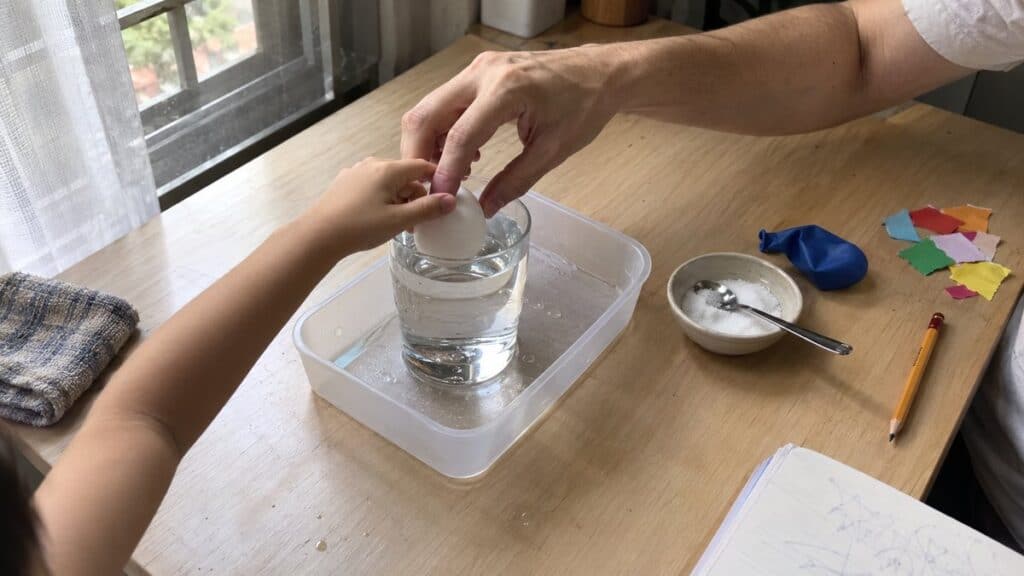
You can run one of the four experiments below this week using household items. Your child makes a prediction, watches what happens, and gives one explanation in their own words. The floating egg is a good first run: it needs an egg, a glass, tap water and table salt. Before any of it, an adult supervises the session and is named as the safety supervisor.
Safety first
Name one adult as the safety supervisor and keep that adult in the room for the whole activity. The safety guidance used here asks for basic adult supervision for younger children. Use a clearly written procedure, and follow it rather than improvising.
Avoid anything with a warning symbol on the label, and anything whose contents you cannot identify. Keep experiments away from food-prep surfaces. Do not eat or taste any material used in them. Keep balloons, and any broken balloon pieces, away from young children. For any chemistry-type work, add safety goggles as a precaution. When you finish, clean up and wash your hands.
The safety guidance behind these points is US-oriented: one source is a lab-safety organisation’s guidance for schools, and the other is a commercial science-education website. Check local guidance and the labels on your products before you start.
1. Floating egg in salt water
You need one raw egg, a clear glass of tap water, table salt, and a spoon.
- Half fill the glass with tap water. Ask your child what they expect the egg to do, then lower it in gently.
- Watch for a minute and note where the egg sits.
- Lift the egg out. Add one spoonful of salt, stir until it dissolves, and put the egg back in. Repeat with more salt if nothing changes.
Watch where the egg sits in the tap water. If it rises after salt goes in, count the spoonfuls it took, and write the number down so the test can be repeated.
Ask your child: “What do you think the salt changed, if anything?”
Supervision: an adult handles the salt and the egg. Do not eat the egg or the salt water. Wash your hands afterwards.
2. Dancing raisins with plain sparkling water
You need a clear glass, plain sparkling water (not cola), and a small handful of raisins.
- Before anything goes in, ask your child what they think the raisins will do.
- An adult pours the sparkling water into the glass.
- Drop in five or six raisins and watch.
Watch whether the raisins rise, sink, or bob up and down, and whether the movement stops after a few minutes. Describe what you see, not what you expected to see.
Ask your child: “What do you think could make the raisins move?”
Supervision: an adult pours and handles the bottle. When you finish, pour the water away and do not drink it. Keep the glass and bottle away from food preparation.
3. Ice on different surfaces
You need four ice cubes of the same size from the same tray, and four flat surfaces: a metal tray, a plastic plate, a folded cloth, and a sheet of aluminium foil.
- Ask your child which surface they think will melt the ice first, and why. Write the guess down.
- Place one cube on each surface at the same time, side by side, in the same room and away from sunlight and fans.
- Check every few minutes and note which cube melts first.
Watch which cube is gone first and how much water is left on each surface. Keep the room conditions the same, so the surface is the only thing that changes.
Ask your child: “Which surface do you think melts the ice first, and what makes you think so?”
Supervision: keep an adult in the room. A younger child can place the cubes and check them with an adult nearby.
4. Balloon and static with paper pieces
You need a balloon, a piece of wool or clean dry hair, and small scraps torn from tissue paper.
- Spread the paper scraps on a table.
- An adult inflates the balloon and ties it.
- Rub the balloon on the wool or hair for a short while. Hold it near the paper without touching the paper. Watch.
Watch whether the scraps move toward the balloon, cling to it, or stay still. Try again with longer rubbing and see whether anything changes.
Ask your child: “What do you think makes the paper move, if it does?”
Supervision: an adult inflates, ties, and handles the balloon. Keep the balloon and any broken pieces away from young children. Collect all the paper and balloon pieces afterwards.
Turning it into a science routine
Use the same three steps for every experiment. Before you start, your child makes a prediction. During the test, they record one observation in their own words. Afterwards, they offer one explanation, and you ask what they would expect to see if one thing changed.
The fair test is the idea behind that last question: change one thing, keep the rest the same. The ice test is a clear example, because only the surface changes. For the raisins, you could ask what would happen with plain tap water in place of sparkling water, then try it and compare.
The MOE primary science syllabus reviewed expects students to recognise a fair test by the end of Primary 4, and to design one by the end of Primary 6. Those are syllabus targets for school learning, and a home routine does not guarantee them. You can use the same routine with younger children, but this article does not map it to Primary 1 or Primary 2 content, since the syllabus reviewed covers only Primary 3 to 6.
Where this fits in the syllabus
The MOE Science Teaching and Learning Syllabus reviewed for this article covers Primary 3 to 6 only. It is organised around five themes: Diversity, Cycles, Systems, Energy, and Interactions. The themes organise the subject. They are not tags that an activity earns. None of the four experiments here is prescribed by MOE or mapped to a specific syllabus item. They are general home activities, and what your child sees is an observation, not a guaranteed result.
The syllabus describes students using everyday materials to test ideas, but it places this in classroom work. The parts reviewed do not mention experiments at home.
If your child is in Primary 5, one programme to look at is the Primary 5 science programme at https://bluetreeeducation.com/tuition-programmes/primary-science/primary-5-science/.
Your next step this week
Run the floating egg once with your child. Ask for a prediction before the egg goes in. Afterwards, have your child write one sentence about what happened, then ask what they would change to test it again.